
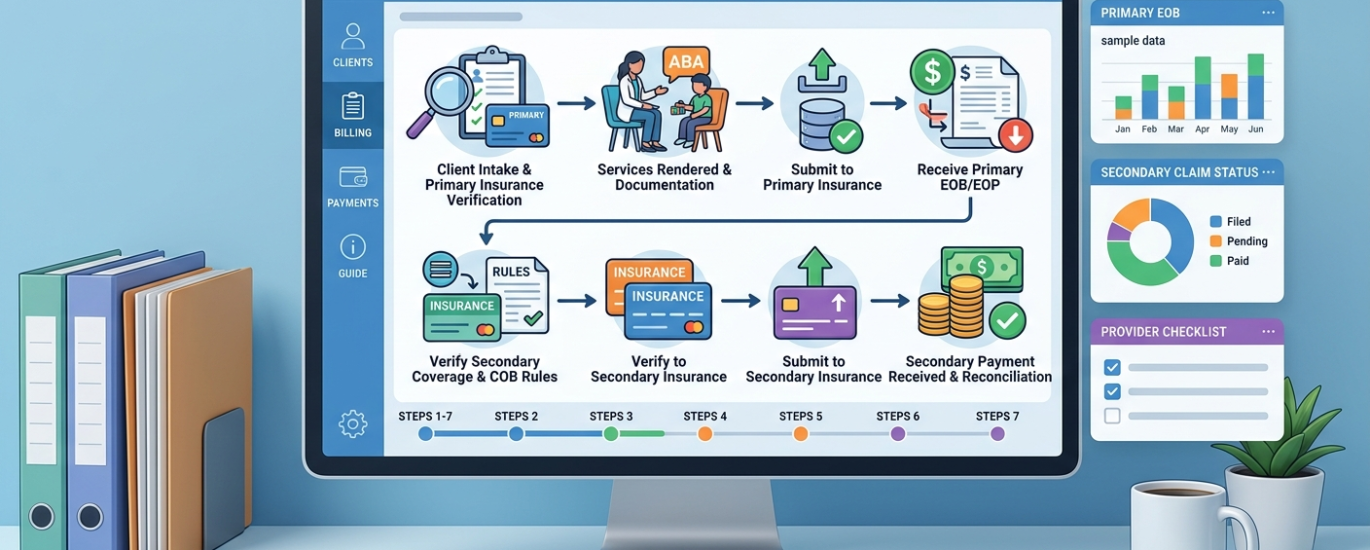
Applied Behavior Analysis (ABA) therapy is one of the most code-intensive and documentation-heavy services in outpatient behavioral health. A single treatment plan can generate dozens of CPT codes per week, each with its own unit calculations, modifiers, and authorization requirements. When a patient has only one insurance plan, the billing workflow — while complex — is at least linear.
When a patient has two plans, that linear workflow disappears. Suddenly, every claim must be routed through a coordination of benefits (COB) process, adjudicated by a primary payer, and then submitted to a secondary payer with the primary’s Explanation of Benefits (EOB) attached. Skip a step, and the secondary claim is denied. Submit too late, and the entire balance becomes a write-off.
This guide explains exactly how to bill secondary insurance for ABA therapy — from determining which plan pays first, to reading the primary EOB, to submitting a clean secondary claim that gets paid without repeated denials.
Why Secondary Billing Matters More in ABA Than Almost Anywhere Else
ABA therapy is expensive. A single 1:1 session billed with CPT 97153 (Adaptive Behavior Treatment by Protocol) typically reimburses between $20 and $32 per 15-minute unit, depending on payer and geography. A moderate-intensity treatment plan of 15 hours per week generates 60 units weekly — roughly $1,200 to $1,920 per week, or $5,000 to $8,000 per month. Over a year, that is $60,000 to $96,000 in billed charges for one patient.
When a secondary payer is left unbilled, that revenue is not simply delayed. It is lost. Secondary insurance exists to cover what the primary plan does not pay — copayments, coinsurance, deductible balances, and in some cases, services the primary plan excludes entirely. For families with dual coverage, failing to bill the secondary plan means the family absorbs costs they should not owe, and the provider collects less than the allowable reimbursement.
The operational challenge is that ABA claims are already resource-intensive. Adding a secondary billing workflow demands staff time, system configuration, and payer-specific knowledge. But the alternative — writing off 20% to 40% of every dual-coverage claim — is not sustainable for any practice.
Step 1: Determine Which Plan Is Primary (Coordination of Benefits)
Before a single claim is submitted, you must confirm the COB order. Secondary payers will not process a claim until the primary payer has adjudicated it. Submitting to the secondary plan first results in an automatic denial, and in some cases, a compliance flag.
The rules that determine primary versus secondary coverage are standardized, but they vary by situation.
| Scenario | Primary Payer | Secondary Payer |
| Child covered under both parents’ employer plans | Parent whose birthday falls earlier in the calendar year (birthday rule) | Parent whose birthday falls later in the year |
| Parent has active employer coverage and retiree/COBRA coverage | Active employer plan | Retiree or COBRA plan |
| Commercial insurance and Medicaid | Commercial insurance | Medicaid (payer of last resort) |
| Commercial insurance and TRICARE | Commercial insurance | TRICARE (with exceptions for active-duty dependents) |
| Injury or accident-related services | Workers’ compensation or liability insurance | Health insurance |
The birthday rule is the most common source of confusion. It applies to dependent children covered under both parents’ plans. The parent whose birthday occurs first in the calendar year — not the older parent, but the one with the earlier birthday month and day — holds the primary plan. If both parents share the same birthday, the plan that has been active longer typically becomes primary.
For ABA specifically, another layer exists: Medicaid. In many states, Medicaid serves as the secondary payer for children who also have commercial coverage. The commercial plan must process the claim first. Only then can Medicaid be billed for the remaining balance, and only within Medicaid’s allowable rate. Medicaid will never pay more than its own fee schedule, even as a secondary payer.
Action step: Verify COB at intake and re-verify annually. Insurance coverage changes frequently. A parent may switch employers, a plan may terminate, or a child may age out of dependent coverage. If your COB data is stale, every secondary claim submitted under that patient will be denied.
Step 2: Bill the Primary Payer First
Once you have confirmed COB, submit the ABA claim to the primary payer exactly as you would for a single-coverage patient. Include all applicable CPT codes — 97151 for behavior identification assessment, 97153 for adaptive behavior treatment by protocol, 97155 for protocol modification by the qualified health professional, and so on — with correct units, modifiers, and authorization numbers.
The primary claim must be clean. If it contains coding errors, missing authorization data, or incomplete patient information, the primary payer will deny or reject it. Fixing a primary claim after the fact and then submitting to the secondary payer creates a chain of corrections that often exceeds the secondary payer’s timely filing window.
Critical point: A primary denial is not a dead end for secondary billing. If the primary payer denies the claim for a reason that the secondary payer may cover — for example, the service is not a covered benefit under the primary plan but is covered under the secondary — you can still bill the secondary with the primary’s denial EOB attached. The secondary payer will review the claim on its own merits.
Step 3: Read the Primary EOB Carefully
The Explanation of Benefits is the single most important document in secondary billing. It tells the secondary payer exactly what the primary plan allowed, paid, adjusted, and assigned to the patient. Without an accurate reading of the EOB, the secondary claim will be rejected for missing or inconsistent data.
The specific fields you need from the primary EOB include:
- Allowed amount: The contracted rate the primary payer recognized for each service line
- Paid amount: What the primary payer actually reimbursed
- Adjustment codes (CARC/RARC): The reason codes explaining why amounts were adjusted or denied
- Patient responsibility: The portion assigned to deductible, copay, or coinsurance
- Claim control number: The primary payer’s internal reference number
A common mistake is to assume that the secondary payer will cover whatever the primary did not pay. This is incorrect. The secondary payer applies its own fee schedule, its own coverage rules, and its own authorization requirements. If the secondary plan does not cover ABA at the same benefit level as the primary, the remaining balance may still fall to the patient.
Step 4: Prepare and Submit the Secondary Claim
Billing secondary insurance is not a matter of resubmitting the same claim. It is a new claim submission that includes the primary payer’s adjudication data. The secondary claim must reflect the same CPT codes, units, and modifiers as the primary claim, plus the primary EOB information.
On a CMS-1500 form, the primary payer’s data goes in boxes 9, 9a, 9b, 9c, and 9d (other insured information) and box 11 (insured’s policy number). For electronic claims, the COB data is carried in the 2330B and 2430 loops of the 837P transaction. The secondary payer needs to see what the primary paid and what the primary adjusted.
Attach the EOB. Most secondary payers — including Medicaid programs and commercial plans — require a copy of the primary EOB with the secondary claim. For electronic claims, the EOB data must be included in the COB segments. For paper claims, a physical copy of the EOB must be attached. Missing EOB attachments are a guaranteed denial.
Step 5: Respect the Secondary Payer’s Timely Filing Limit
This is where most ABA practices lose money on secondary billing. Secondary claims have their own timely filing deadlines, and those deadlines are almost always shorter than the primary payer’s window.
Most secondary payers allow 60 to 120 days from the date of the primary EOB, not the original date of service. Some Medicaid programs allow up to 365 days from the primary determination date. But many commercial secondary plans allow only 60 days. A secondary claim submitted on day 61 is denied with no appeal rights.
Operational control: Build a secondary billing queue into your practice management system. When the primary EOB posts, the claim should automatically move into a secondary billing worklist with a deadline alert. The goal is to submit secondary claims within 30 days of primary adjudication — well inside even the tightest filing windows.
A Scenario from the Field
I once worked with an ABA practice that had been leaving money on the table for over a year without realizing it. The practice served a large pediatric population in a state where most children with autism had commercial insurance through a parent’s employer plus Medicaid as a secondary payer. The billing team was diligent about primary billing. They submitted every 97153 claim, tracked authorizations, and followed up on primary denials.
But they were not billing Medicaid as the secondary payer. The reasoning, as the billing manager explained it, was that “Medicaid doesn’t pay for ABA anyway.” That assumption was wrong. In that state, Medicaid covered ABA for children under a specific age and income threshold, and when commercial insurance was primary, Medicaid would cover the remaining patient responsibility after the commercial plan paid.
The practice had been writing off copayments, coinsurance, and deductible balances for these patients — approximately $180 per patient per week. With 40 dual-coverage patients, that was $7,200 per week in unbilled secondary claims, or nearly $375,000 annually.
We implemented a secondary billing workflow: EOB capture, COB data entry, Medicaid claim submission, and timely filing tracking. Within 90 days, the practice recovered $62,000 in retroactive Medicaid payments for claims still within the filing window. The remaining claims were lost to timely filing, but the forward-looking workflow prevented further leakage.
The lesson was not about Medicaid rules or COB mechanics. It was about assumptions. The billing team assumed secondary billing was not worth the effort. In reality, it was the single largest revenue recovery opportunity in the practice.
Common Secondary Billing Mistakes in ABA
The following mistakes account for the majority of secondary claim denials in ABA practices.
Billing the secondary payer before the primary has adjudicated the claim. Secondary payers will reject any claim that does not show a primary payment or denial. There is no exception. The primary EOB must exist before the secondary claim is submitted.
Submitting the secondary claim without the primary EOB. For paper claims, the EOB must be attached. For electronic claims, the COB data must be populated in the correct loops. Missing EOB data results in a rejection or denial.
Using the wrong primary payer information on the secondary claim. The primary payer’s name, claim control number, and payment amount must be accurate. If the secondary payer cannot match the claim to the primary adjudication, the claim is denied.
Missing the secondary payer’s timely filing deadline. As noted above, secondary filing windows are shorter. A claim that is timely for the primary payer may be late for the secondary payer.
Assuming the secondary payer covers everything the primary did not. The secondary payer applies its own coverage rules. If the secondary plan does not cover ABA, or covers it at a lower rate, the remaining balance may become patient responsibility.
Failing to verify secondary benefits at intake. Not all secondary plans cover ABA. Some have annual dollar caps, visit limits, or age restrictions. Verifying benefits before services are rendered prevents billing surprises.
Best Practices for ABA Secondary Billing
Verify COB and secondary benefits at intake. Do not assume a secondary plan covers ABA. Confirm benefit details, authorization requirements, and any caps or exclusions.
Configure your billing system for COB. Most practice management systems support primary and secondary payer fields. Use them. Manual tracking of secondary claims is error-prone and does not scale.
Build a secondary billing worklist with deadline alerts. Every primary EOB should trigger a secondary claim within 30 days. Deadline alerts prevent timely filing failures.
Train billing staff on EOB reading. The ability to identify allowed amounts, adjustment codes, and patient responsibility is the foundation of accurate secondary billing.
Audit secondary claims quarterly. Review a sample of secondary claims to identify patterns of denials or underpayments. If one payer consistently denies a particular code combination, investigate and adjust your workflow.
Document everything. Retain primary EOBs, secondary claim submissions, and payer responses for at least six years. If a secondary payer denies a claim that you believe was filed timely, the documentation is your only recourse.
Frequently Asked Questions
1. What is the difference between primary and secondary insurance in ABA billing?
The primary insurance processes the claim first. The secondary insurance reviews the remaining balance after the primary has paid, adjusted, or denied. Secondary insurance is sometimes called “supplemental” or “wrap-around” coverage.
2. Can I bill secondary insurance before the primary has processed the claim?
No. Secondary payers require proof of primary adjudication — typically an Explanation of Benefits (EOB) — before they will process a claim. Submitting to the secondary payer first results in an automatic denial.
3. How do I determine which parent’s insurance is primary?
The birthday rule applies: the parent whose birthday falls earlier in the calendar year holds the primary plan for dependent children. If both parents have the same birthday, the plan active longer typically becomes primary.
4. Does Medicaid cover ABA therapy as a secondary payer?
It depends on the state. Many state Medicaid programs cover ABA for children who meet specific age and income criteria. When Medicaid is secondary, it pays the remaining patient responsibility after the commercial plan pays, but never more than Medicaid’s allowable rate.
5. What happens if the primary payer denies the ABA claim?
If the primary payer denies the claim, you can still bill the secondary payer with the primary’s denial EOB attached. The secondary payer will review the claim on its own merits. If the service is covered under the secondary plan, it may pay.
6. How long do I have to submit a secondary claim?
Secondary timely filing limits vary by payer, but most fall between 60 and 120 days from the primary EOB date. Some Medicaid programs allow up to 365 days. Always verify the specific payer’s deadline.
7. What documentation is required for ABA secondary claims?
The secondary claim requires the same CPT codes and units as the primary claim, plus the primary payer’s EOB data — allowed amount, paid amount, adjustment codes, and patient responsibility. For paper claims, a copy of the EOB must be attached.
8. Why was my secondary ABA claim denied for “no primary EOB on file”?
This denial means the secondary payer did not receive the primary EOB data. For electronic claims, the COB loops (2330B and 2430) must be populated. For paper claims, the EOB must be attached. Verify that your billing system is transmitting COB data correctly.
Looking for more ABA billing and revenue cycle insights? Subscribe to the Med Revenue Hub newsletter for expert guidance on medical billing, claim submissions, and practice management.