
If you manage billing for a hospital, skilled nursing facility, or any outpatient department, you are likely familiar with the UB-04 form. Officially known as the CMS-1450, the UB-04 is the standardized claim form used by institutional providers to bill Medicare, Medicaid, and commercial insurance payers .
While the CMS-1500 is used for professional claims (like a physician’s office visit), the UB-04 is designed for the complex nature of facility billing. It captures everything from room and board charges to operating room minutes and detailed supply costs. Understanding how to fill this form out correctly is essential for maintaining a healthy revenue cycle and avoiding costly claim denials.
In this guide, we will break down the structure of the UB-04, explain the most critical fields, and provide best practices for submission.
UB-04 vs. CMS-1500: Understanding the Difference
Before diving into the form locators, it is important to distinguish between the two main claim forms in medical billing .
| Feature | UB-04 (CMS-1450) | CMS-1500 |
| Who Uses It | Hospitals, inpatient facilities, outpatient clinics, skilled nursing facilities, and home health agencies. | Physicians, nurse practitioners, physical therapists, and non-institutional providers. |
| Type of Billing | Institutional billing (facility costs, bed days, supplies, equipment). | Professional billing (provider services, consultations, procedures). |
| Key Data Structure | Revenue codes (e.g., 0450 for ER) paired with HCPCS/CPT codes. | Primarily CPT/HCPCS codes with ICD-10 pointers. |
| Electronic Version | 837I (Institutional) | 837P (Professional) |
Structure of the UB-04: Key Form Locators
The UB-04 form consists of 81 Form Locators (FLs) . While it may look overwhelming, the form is logically grouped into patient information, provider information, and claim detail sections .
Here is a breakdown of the most critical fields you need to get right.
Section 1: Patient & Provider Identification (FL 1-12)
This section establishes who is billing and who was treated.
- FL 1 – Provider Name, Address, and Telephone: Enter the billing provider’s physical address. Do not use a P.O. Box here, as this must match the National Provider Identifier (NPI) enrollment data .
- FL 3a – Patient Control Number: This is an optional internal ID number used by your facility to track the patient in your system. It will appear on the remittance advice, making it easier to post payments .
- FL 4 – Type of Bill (TOB): This is a three-digit code that is critical for processing.
- First Digit: Type of facility (e.g., 1 = Hospital, 8 = Critical Access Hospital/Swing Bed).
- Second Digit: Classification (e.g., 1 = Inpatient, 3 = Outpatient, 7 = Clinic).
- Third Digit: Frequency (1 = Admit through Discharge, 7 = Replacement/Adjustment, 8 = Void) .
- Example: 111 = Hospital Inpatient, Admit through Discharge claim. 131 = Hospital Outpatient, Admit through Discharge .
Section 2: Patient Status & Admission Details (FL 14-17)
These fields provide context for the episode of care, which affects medical necessity review.
- FL 14 – Priority (Type) of Admission: Indicates if the admission was emergent, urgent, elective, or trauma-related.
- FL 17 – Patient Discharge Status: This two-digit code is crucial for Medicare. For example, 01 (Discharged to home or self-care) vs. 03 (Discharged to skilled nursing facility) vs. 06 (Discharged to home under home health). Incorrect discharge status can result in denied payment .
Section 3: Value Codes & Occurrence Codes (FL 31-41)
These fields capture specific financial data and events.
- FL 31-34 – Occurrence Codes and Dates: Used to define significant events, such as the date of an accident or the date benefits were exhausted. For example, Code C3 indicates the date Medicare benefits were exhausted .
- FL 39-41 – Value Codes and Amounts: Used for numeric values like covered days, deductibles, or birth weight. Value Code 80 is used to report the number of covered days for inpatient stays .
Section 4: The Detail Lines (FL 42-49)
This is the heart of the claim where charges are itemized. Unlike the CMS-1500 (which lists procedures), the UB-04 groups charges by Revenue Codes.
| FL | Field Name | Description & Best Practices |
| 42 | Revenue Code | A four-digit code defining the specific accommodation or ancillary service (e.g., 0450 = Emergency Room, 0300 = Lab). Revenue code 0001 is used as a “total charge” line . |
| 44 | HCPCS/Rate | For outpatient claims, many payers now require HCPCS/CPT codes here alongside the revenue code. Payer policies, such as Blue Cross of Idaho, often require HCPCS codes for most revenue codes on commercial outpatient claims to avoid denials . |
| 46 | Service Units | A quantitative measure. For accommodation codes (like Room & Board), this is the number of days. For ancillary services, this could be the number of units, miles, or pints of blood . |
| 47 | Total Charges | The total charge for that specific revenue code line item . |
Section 5: Diagnosis & Provider Information (FL 67-76)
- FL 67 – Principal Diagnosis Code: Enter the full ICD-10-CM code for the primary reason for the visit or hospitalization. This field also requires the Present on Admission (POA) indicator, which tells the payer if the condition existed at the time of admission (Y, N, W, or U) .
- FL 67 A-Q – Other Diagnosis Codes: Additional ICD-10 codes that affect the treatment or length of stay.
- FL 76 – Attending Provider NPI: The NPI of the provider who has overall responsibility for the patient’s care .
Common UB-04 Errors and How to Avoid Them
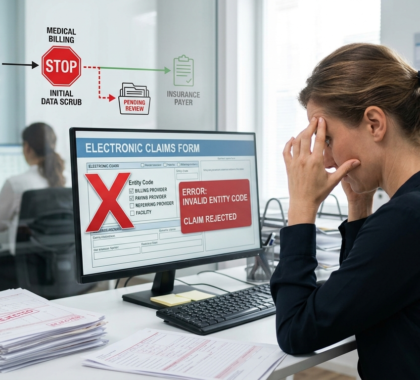
Even small mistakes on the UB-04 can lead to rejections or underpayments. Here are the most frequent pitfalls to watch out for:
- Invalid Type of Bill (FL 4): Using an outdated or incorrect TOB (e.g., using 13X for a service that requires 85X for Critical Access Hospitals) is an instant denial .
- Missing HCPCS Codes: As noted by commercial payers like Blue Cross of Idaho, failing to append HCPCS codes to revenue codes (except for specific exemptions) will result in denied line items .
- Incorrect Discharge Status (FL 17): Medicare relies heavily on this code. A “01” (home) when the patient actually went to a SNF (03) can lead to a recovery audit contractor (RAC) audit down the line.
- Mismatched NPI and Provider Name: The name in FL 1 must correspond with the NPI in FL 56. If they don’t match the Medicare enrollment database, the claim will reject .
Institutional Billing Changes and Compliance Focus
The UB-04 (CMS-1450) is the cornerstone of institutional billing, but 2026 brings important updates. Hospitals, skilled nursing facilities, and outpatient departments must stay current with Form Locator (FL) changes or face increased denials.
FL 4 (Type of Bill) remains the most critical field. The three-digit code must exactly match the service type and frequency. For outpatient claims, use 13x. For inpatient, use 11x. For replacements or adjustments, use the correct third digit (7 for replacement, 8 for void). An incorrect Type of Bill is an instant rejection.
FL 42-44 (Revenue Code and HCPCS) pairing is now strictly enforced. Most payers require HCPCS codes in FL 44 for outpatient claims, even when the revenue code alone might suggest coverage. Without the HCPCS code, line items are denied. Common pairings: 0450 (Emergency Room) with 99281-99285, 0300 (Laboratory) with appropriate lab CPT codes.
FL 17 (Patient Discharge Status) is a major audit focus. Medicare uses this code to determine post-acute care planning and payment. Code 01 (home/self-care) versus 03 (skilled nursing facility) has significant financial implications. Incorrect coding triggers Recovery Audit Contractor (RAC) reviews. Ensure discharge planners document the actual disposition accurately.
FL 67 (Principal Diagnosis) now requires Present on Admission (POA) indicators for all diagnosis codes. The POA indicator (Y, N, W, U) tells the payer whether the condition existed at admission. Missing POA indicators cause claim rejections. Train clinical documentation improvement (CDI) staff to capture POA accurately.
FL 76 (Attending Provider NPI) must match the enrolled attending physician. For teaching hospitals, the attending NPI cannot be a resident or fellow. Payers verify that the attending NPI is eligible to bill for the service type.
Electronic claims (837I) are now required for most institutional providers. Paper UB-04 claims are accepted only in limited circumstances. Ensure your billing system generates compliant 837I files and that your clearinghouse is approved to transmit institutional claims.
Key takeaway: UB-04 accuracy requires coordination between clinical documentation, medical coding, and billing teams. Errors often originate in the medical record, not the billing office. Regular audits of both documentation and claim data are essential for compliance and revenue integrity.
Electronic vs. Paper Submission
While the paper UB-04 still exists, most payers prefer electronic submission via the 837I (Institutional) transaction . Electronic claims process faster, cost less, and have fewer data entry errors.
However, understanding the paper form is crucial for troubleshooting. When an electronic claim rejects, the error report often references specific Form Locators. If you must mail a paper claim, ensure the form is the most current version (often referred to as the “red form”) and printed with high-quality black ink to support optical character recognition (OCR) scanning .
Conclusion
The UB-04 (CMS-1450) is a complex but essential tool for institutional healthcare providers. Accurate completion requires attention to detail specifically regarding Type of Bill codes, Revenue Code/HCPCS combinations, and Patient Discharge Status.
By ensuring your billing staff understands the nuances of these key form locators, you can significantly reduce denials, accelerate cash flow, and maintain compliance with federal and commercial payer requirements.
Frequently Asked Questions
1. What is a UB-04 form?
The UB-04 (also called CMS-1450) is the standard claim form used by institutional providers—hospitals, skilled nursing facilities, home health agencies, and outpatient departments—to bill Medicare, Medicaid, and commercial insurers.
2. What is the difference between UB-04 and CMS-1500?
UB-04 is for facility/institutional billing (room & board, supplies, equipment). CMS-1500 is for professional billing (physician services). UB-04 uses revenue codes plus HCPCS; CMS-1500 uses CPT/HCPCS with diagnosis pointers.
3. What is Form Locator 4 on UB-04?
FL 4 is the Type of Bill (TOB) – a three-digit code. Example: 111 = Hospital inpatient, admit through discharge. 131 = Hospital outpatient. 851 = Critical access hospital. An incorrect TOB is a common denial reason.
4. What is Form Locator 17 on UB-04?
FL 17 is Patient Discharge Status – a two-digit code indicating where the patient went after discharge (e.g., 01 = home, 03 = skilled nursing facility, 06 = home health). Medicare uses this for payment calculations.
5. Do I need HCPCS codes on UB-04?
For outpatient claims, yes. Most payers (including many Blue Cross plans) require HCPCS/CPT codes in FL 44 alongside revenue codes. Without them, line items may be denied.
6. Where do ICD-10 codes go on UB-04?
ICD-10 diagnosis codes go in FL 67 (principal diagnosis) and FL 67A–Q (other diagnoses). You must also include the Present on Admission (POA) indicator for each diagnosis.